
316L vs. 318LN: Choosing the Ultimate Anchor Chain for Your Vessel
Updated: Apr 18

When you have owned boats for decades, you develop a sixth sense for equipment. You know that out on the water, the most expensive marketing gimmick rarely translates to the safest night at anchor.
Recently, there has been a massive push in the marine industry trying to convince seasoned boat owners that they need to abandon standard 316L stainless steel and upgrade to 318LN Duplex stainless steel chain (UNS S32205/S31803). The sales pitch sounds compelling: “It’s twice as strong! It’s completely rust-proof! It's the ultimate marine metal!”
But let’s sit down and look at the actual physics of anchoring and the raw metallurgy behind the claims. As a captain, you aren't buying a chain for a laboratory stress test; you are buying a chain to hold your vessel safe in a 45-knot squall at 3 AM while you sleep.
At ShakeSure, we supply some of the most demanding vessels and windlass manufacturers worldwide. We have analyzed the metallurgy, the windlass mechanics, and the real-world anchoring dynamics. Our conclusion is absolute: for the vast majority of boat owners, a highly refined, electropolished Ultra-Grade 1.4435 (316L) anchor chain is vastly superior in practical application to 318LN.
Here is the unfiltered, professional breakdown of exactly why the industry is pushing 318LN, and why ShakeSure’s advanced 1.4435 High-Molybdenum alloy remains the undisputed king of the bow roller.
1. The Metallurgy Reality: Standard 316L vs. 1.4435 vs. 318LN

To understand the debate, we must establish scientific accuracy.
318LN (Duplex 2205) is a hybrid metal. Its microscopic structure is a 50/50 split between austenitic and ferritic steel. The "LN" designates a High Nitrogen content, which is the true soul of its extreme strength and high-level corrosion resistance.
Standard 316L (often designated as 1.4404) is a purely austenitic steel. Historically, standard 316L (1.4404) has had a lower yield strength than Duplex and was susceptible to cosmetic "tea staining" or crevice corrosion if buried in anaerobic, salty mud for months. This historical weakness is the exact loophole salespeople use to scare you into buying expensive 318LN.
The Missing Link: The 1.4435 "Killer App" Here is the secret the industry doesn't want to talk about: Not all 316L is created equal. At ShakeSure, we do not use standard 1.4404 commercial steel. We utilize Ultra-Grade EU 1.4435 alloy. This is a highly specialized European variant of 316L characterized by a significantly higher molybdenum composition (Mo ≥ 2.5%). Molybdenum is the crucial element that dictates a metal's resistance to pitting and crevice corrosion in seawater.
By aggressively elevating the molybdenum content, our 1.4435 alloy completely bridges the massive gap between standard 316L and 318LN Duplex. You get the reliable anchoring physics of 316L, but with a corrosion defense that rivals aerospace metals.
The Science of Survival: PREN Values Explained
When dealing with B2B marine engineers and high-end yachtsmen, we do not rely on adjectives; we rely on data. The global standard for measuring a metal's ability to resist localized pitting corrosion in saltwater is the PREN (Pitting Resistance Equivalent Number).
Let's look at the hard numbers:
Standard 316L (1.4404): PREN ~24 (Prone to tea-staining in harsh, stagnant marine environments).
ShakeSure 1.4435 (Ultra-Grade 316L): PREN ~26.6 (The Gold Standard. Easily handles severe marine environments without cosmetic failure).
318LN (Duplex 2205): PREN ~35 (Extreme defense, but comes with rigidity and cost compromises).
By starting with a baseline PREN of ~26.6, ShakeSure's 1.4435 definitively outclasses standard marine chains, providing peace of mind without the extreme premium of Duplex.
The Surface Reality: Why Electropolishing (EP) is Mandatory
Raw chemistry is only half the battle. A critical fact often hidden by budget manufacturers is this: Even if you pay thousands of dollars for a 318LN Duplex chain, if it is not properly Electropolished, it will still rust.
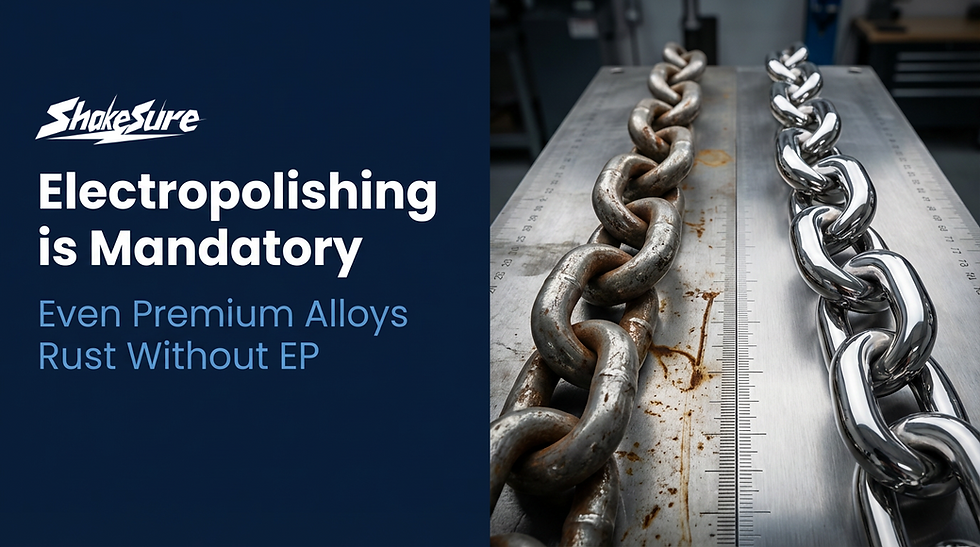
Microscopic abrasions, free iron, and welding impurities act as the origin points for rust. Many budget factories skip Electropolishing (EP) to cut costs.
At ShakeSure, Electropolishing is not an optional upgrade; it is the absolute baseline. Our proprietary multi-stage surface treatment integrates:
Mechanical & Manual Polishing: To smooth heavy weld points.
Electropolishing (EP): A highly controlled electrochemical bath that strips away superficial iron and impurities.
Deep Passivation: Artificially thickening the chromium-oxide shield.
This guarantees a flawless, high-luster marine finish that actively repels mud and salt.
The Strength Paradox: Why Stronger (318LN) Is Actually Dangerous
318LN is undeniably harder and has a higher tensile strength than standard 316L. Because of this, salesmen will try to convince you to downsize your chain to save bow weight (e.g., dropping from a 10mm chain to an 8mm 318LN).
This is a fatal misunderstanding of anchoring physics.
In anchoring, weight is your absolute best friend. The weight of the chain creates the catenary curve (the heavy sag). When a violent gust of wind hits your bow, the kinetic energy is absorbed by lifting that heavy chain off the seabed. The anchor itself barely feels a thing.
If you downsize to a lighter 318LN chain, you lose that catenary shock absorber. Your chain becomes a rigid, bar-tight tripwire. The massive kinetic load transfers instantly to your windlass and directly to the shank of your anchor, violently jerking it right out of the sand. You will drag. Furthermore, 318LN is highly rigid and lacks the ductile forgiveness of 316L, making it more prone to sudden, brittle failure under catastrophic shock loads.
ShakeSure’s 1.4435 is engineered to offer ductile resilience, acting as the ultimate shock absorber. Through advanced heat treatment, we achieve G60 strength (up to 10mm) and G50 strength (10-20mm), providing a massive safety margin without losing critical chain weight.
At a Glance: ShakeSure 1.4435 vs. Standard 316L vs. 318LN
Feature | Standard 316L (1.4404) | ShakeSure Ultra 316L (1.4435) | 318LN (Duplex 2205) |
PREN Value | ~24 | ~26.6 (Gold Standard) | ~35 |
Molybdenum (Mo) | ~2.0% | ≥ 2.5% | ~3.0% |
Corrosion Defense | Good (Prone to tea-staining) | Exceptional (No tea-staining) | Ultimate |
Surface Treatment | Often raw or just tumbled | 100% Electropolished (EP) | Often skips EP to save cost |
Shock Absorption | Excellent | Excellent (Ductile yield) | Poor (Rigid/Brittle failure risk) |
Windlass Fitment | Variable | 100% Precise (Flawless) | Often inconsistent |
The Windlass Fitment: The Silent Dealbreaker
Because 318LN Duplex is so incredibly hard, it is notoriously difficult to bend and weld into perfectly calibrated links. An inconsistent pitch means the chain will violently jump or jam in your windlass gypsy.
Because ShakeSure utilizes premium 1.4435, we have absolute control over dimensional manufacturing. We have engineered strictly calibrated lines to ensure a flawless, jumping-free fitment for any windlass:
The Captain's Verdict: Smart Engineering Over Expensive Hype
Buying a 318LN chain is, in almost all practical applications, an expensive over-engineering trap that forces you to compromise your anchoring physics.
ShakeSure’s 1.4435 High-Molybdenum alloy offers the perfect equilibrium: the weight required for a secure catenary curve, a PREN value of 26.6 for immense corrosion defense, mandatory Electropolishing for surface perfection, and absolute dimensional precision for your windlass.
We stand by our steel. Every single chain features traceable 316L & SKS marking, and a Mill Test Certificate (MTC) is provided with every batch.
(Warning: Regardless of the grade you choose, never exceed the Working Load Limit!)
Do not leave your vessel's safety to guesswork. Contact ShakeSure today for our expert one-on-one fitment verification service. We will consult with you directly to ensure 100% windlass compatibility before you order.


Comments